I had a wonderful meeting this week with Portland's own Board Certified Veterinary Behaviorist, Dr. Chris Pachel of Animal Behavior Clinic. My expectations were high - before leaving Florida, Dr. Lisa Radosta (also a veterinary behaviorist - believe it or not they are two of only about 60 in the country) told me if we were headed to Portland, Oregon that I had to get in touch with Dr. Pachel. She said he was an incredible behaviorist and an equally positive personality. I had dealt with him already through a client that we shared, and hadn't been disappointed.
It was a great meeting. Dr. Pachel is very down-to-earth, which means that even though he has incredible education and experience, he is easy to relate to. I appreciate his approach to behavior and medicine. It will be hard to know until we interact more, but I feel like his methods are very similar to mine, which will make it easy to refer my clients when they need his help, as well as to work with referrals of his patients to help them with follow through and moving their dog's behavior in a positive direction.
It's fantastic to know that I have a resource in Dr. Pachel. For those of you that don't know, his position is why I never refer to myself as a "behaviorist." Trainers that do are using the word inappropriately, because unlike dog training, there is a medical degree that makes someone officially a "behaviorist." What's the difference?
Dog trainers can work on a variety of things, including socializing puppies, house training, obedience training (like teaching sit,down, stay, come, heel, etc.) and changing problem behaviors like jumping up, bolting through doors or barking at squirrels in the yard. A dog trainer may also choose to handle some behavior cases, if they have the education and experience to do so. Those may include mild cases of separation anxiety, house training problems in grown dogs, or a dog who is afraid of the vacuum cleaner. Some trainers handle aggression and some don't - if you are looking for help with aggression make sure you find someone who is qualified and who uses positive methods.
A veterinary behaviorist isn't likely to be much help for acclimating your new puppy to playing well with other puppies, or for teaching your dog to sit for meeting visitors. But a veterinary behaviorist may be the right resource for a dog that has extreme fears or compulsions, or for a dog that is so intense in guarding his toys that he has bitten family members in the process. A veterinary behaviorist can rule out medical causes, can create a behavior modification plan that is appropriate for a dog with complex training needs, and can prescribe medication if that is something that will be helpful in the animal's recovery.
We are fortunate to have a veterinary behaviorist in the Northwest, and even luckier that it is someone as caring and personable as Dr. Chris Pachel!
Thursday, April 19, 2012

Tuesday, April 17, 2012
Clicker 101 - Part One
Have you heard about clicker training, but don't know what it is? How it got started? Why they are used? What all the fuss is about? And, hey, are they worth it, or is the clicker just another gizmo you'd be forced to juggle, as if the dog, leash, treats and poop bags weren't enough?!
I'll start with some of the history of clicker training, and what it does, and then (in the interest of brevity, so this post stays short enough for you to read and me to write) I'll go into more detail in follow up posts. Like how to use a clicker, and common concerns about clicker training. I'll probably throw in a video at the end, so you can see clicker training in action and decide for yourself what you think of it (though I think trying it with your dog for a few weeks is the best way to give it a true trial).
So, where did clicker training begin? The concept originated around the time of WWII with Marian Kruse and Keller Breland, students of the famous B. F. Skinner. They used clicker training to teach a wide animals including pigeons, cats and dolphins. Its use in training marine mammals took off (instead of a click trainers use the high pitched whistle we now associate with Flipper and Shamu, but the concept is the same), but clicker training still hadn't really made it to dogs.
One behavior expert was using clicker training with dogs though, and in 1992 Karen Pryor put on a seminar in San Diego, California that would change the face of dog training forever. Along with her book, Don't Shoot the Dog, Pryor began to spread awareness of clicker training and the fantastic results it could bring when teaching obedience commands or modifying behavior.
The basic principles of clicker training are quite simple. The "click," that sound made by the clicker, becomes what is known as a conditioned reinforcer. It is a sound that initially means nothing to a dog; it is quite literally just a click. But, after repeated pairings with food rewards, the click begins to take on meaning. It starts to mean "Yes! You got it right!" It means food is coming, even if you can't see it yet. And it means "All done!" that whatever behavior they have been working on is complete.
How does one sound come to mean so much to a dog? That's where the "conditioned" part of conditioned reinforcer comes in. Let's use dolphins as an example. It's one of my favorites, as you know if you've learned clicker training with me. Training a dolphin offers some unique challenges. You can't put a choke collar on a dolphin and make it mind. You can't flip it over and pin it to the ground, exerting your "dominance" over him, the way some famous "trainers" would. (Since we can't express sarcasms well in the written word, let me just insert that here. I do not advocate choke collars or dominating your dog, or any creature for that matter. Sarcastic sneer noted.)
Dolphins also swim much better than we do, which makes it hard for us to be near them when they are performing tricks. Training dogs is starting to sound pretty easy, right? Clicker training (or "marker training" - a more general term that can include other types of sounds like the whistle that marine mammal trainers are likely to use) helps with dolphin training in many ways. First, by giving the dolphins a consistent, easy to recognize cue that means the dolphin has done something right, we improve communication and thus speed up training. Marking the exact moment a dolphin performs also allows the trainer to reward for increments of behavior, not just the final product.
Finally, the whistle acts as a bridge (lots of fancy terms this time!). A bridge (in normal-person language) is a way to increase the amount of time between when the behavior is performed and when the reward is received, without ruining the animal's understanding of why they are being rewarded. Think of a dolphin learning to jump up and touch a ball suspended 20 feet above the pool. (I have no idea about dolphin training, and it's been a while since I've seen a show, so forgive me if my example is totally inaccurate.) It would be nearly impossible to get a fish to the dolphin at the exact moment that he touches the ball, since the dolphin is way out in the middle of the pool (and 20 feet in the air!) and the trainer is stuck on their little platform. If the dolphin doesn't get his fish within a few seconds of performing the behavior, he won't connect the two. Enter marker training (clicker training if you missed all the bouncing around with terminology)! Because the dolphin has been conditioned to know that the whistle means a fish is coming, the trainer blows the whistle at the exact moment the dolphin touches the ball and, bingo! Dolphin makes the connection and learns the new behavior. And you and your friends pay an arm and a leg to see his show.
What does all this mean for you and your dog? Clicker training isn't just a gimmick, but an effective method based on scientific learning principles. Using a clicker allows you to be clear and consistent in your communication about when your dog has done something right, and also allows you to break a behavior into smaller parts as they are learning. And once your dog is conditioned to the clicker, you can afford more time between the time the dog does a behavior and the time your get the reward to him.
I'll start with some of the history of clicker training, and what it does, and then (in the interest of brevity, so this post stays short enough for you to read and me to write) I'll go into more detail in follow up posts. Like how to use a clicker, and common concerns about clicker training. I'll probably throw in a video at the end, so you can see clicker training in action and decide for yourself what you think of it (though I think trying it with your dog for a few weeks is the best way to give it a true trial).
So, where did clicker training begin? The concept originated around the time of WWII with Marian Kruse and Keller Breland, students of the famous B. F. Skinner. They used clicker training to teach a wide animals including pigeons, cats and dolphins. Its use in training marine mammals took off (instead of a click trainers use the high pitched whistle we now associate with Flipper and Shamu, but the concept is the same), but clicker training still hadn't really made it to dogs.
One behavior expert was using clicker training with dogs though, and in 1992 Karen Pryor put on a seminar in San Diego, California that would change the face of dog training forever. Along with her book, Don't Shoot the Dog, Pryor began to spread awareness of clicker training and the fantastic results it could bring when teaching obedience commands or modifying behavior.
The basic principles of clicker training are quite simple. The "click," that sound made by the clicker, becomes what is known as a conditioned reinforcer. It is a sound that initially means nothing to a dog; it is quite literally just a click. But, after repeated pairings with food rewards, the click begins to take on meaning. It starts to mean "Yes! You got it right!" It means food is coming, even if you can't see it yet. And it means "All done!" that whatever behavior they have been working on is complete.
How does one sound come to mean so much to a dog? That's where the "conditioned" part of conditioned reinforcer comes in. Let's use dolphins as an example. It's one of my favorites, as you know if you've learned clicker training with me. Training a dolphin offers some unique challenges. You can't put a choke collar on a dolphin and make it mind. You can't flip it over and pin it to the ground, exerting your "dominance" over him, the way some famous "trainers" would. (Since we can't express sarcasms well in the written word, let me just insert that here. I do not advocate choke collars or dominating your dog, or any creature for that matter. Sarcastic sneer noted.)
Dolphins also swim much better than we do, which makes it hard for us to be near them when they are performing tricks. Training dogs is starting to sound pretty easy, right? Clicker training (or "marker training" - a more general term that can include other types of sounds like the whistle that marine mammal trainers are likely to use) helps with dolphin training in many ways. First, by giving the dolphins a consistent, easy to recognize cue that means the dolphin has done something right, we improve communication and thus speed up training. Marking the exact moment a dolphin performs also allows the trainer to reward for increments of behavior, not just the final product.
Finally, the whistle acts as a bridge (lots of fancy terms this time!). A bridge (in normal-person language) is a way to increase the amount of time between when the behavior is performed and when the reward is received, without ruining the animal's understanding of why they are being rewarded. Think of a dolphin learning to jump up and touch a ball suspended 20 feet above the pool. (I have no idea about dolphin training, and it's been a while since I've seen a show, so forgive me if my example is totally inaccurate.) It would be nearly impossible to get a fish to the dolphin at the exact moment that he touches the ball, since the dolphin is way out in the middle of the pool (and 20 feet in the air!) and the trainer is stuck on their little platform. If the dolphin doesn't get his fish within a few seconds of performing the behavior, he won't connect the two. Enter marker training (clicker training if you missed all the bouncing around with terminology)! Because the dolphin has been conditioned to know that the whistle means a fish is coming, the trainer blows the whistle at the exact moment the dolphin touches the ball and, bingo! Dolphin makes the connection and learns the new behavior. And you and your friends pay an arm and a leg to see his show.
What does all this mean for you and your dog? Clicker training isn't just a gimmick, but an effective method based on scientific learning principles. Using a clicker allows you to be clear and consistent in your communication about when your dog has done something right, and also allows you to break a behavior into smaller parts as they are learning. And once your dog is conditioned to the clicker, you can afford more time between the time the dog does a behavior and the time your get the reward to him.
Saturday, April 14, 2012
And the Winner Is...
My husband and I had a wonderful time tonight at the Pilgrim Lutheran School fundraising auction and dinner. Bravo Dog Training raised some money for the school with a dog training basket - full of great toys, treats and more, plus a certificate for either a board and train program or private lessons. I didn't see the final bid, but I know we raised about $400 for Ethan's school. Thanks to everyone who bid!
Here's Ethan with me, ready to head out to the auction. It was a country-western theme, hence the blue jeans. Yes, I do wear pants other than blue jeans; it has been known to happen. Once or twice. Ethan played with the other kids in a babysitting room, so Mom and Dad got to enjoy the night like proper grown ups. It was a fun event.

Here's Ethan with me, ready to head out to the auction. It was a country-western theme, hence the blue jeans. Yes, I do wear pants other than blue jeans; it has been known to happen. Once or twice. Ethan played with the other kids in a babysitting room, so Mom and Dad got to enjoy the night like proper grown ups. It was a fun event.

Earlier today I had an initial session with a wonderful couple from our church, Cedar Hills United Church of Christ. They have a very enthusiastic 2-year-old Lab who will be a ton of fun to train. The family has been through a couple other trainers that they weren't happy with, but after our session today they asked to schedule 6 additional sessions! I think it will be a good match, and I'm happy that they have found a trainer that can work with them to mold their zealous (okay, cover your ears puppy, obnoxious) Labrador into a model citizen. Oh, and I'm happy that trainer is me! I do love the wild and crazy dogs. It is so much fun to take all that energy and redirect it to positive, useful behaviors.
One problem that we got to work on right away was the dog's habit of darting out the front door and playing a joyous (for the dog, let me be clear. Owners, not-so-joyous) game of catch-me-if-you-can. Let's be honest, even for an Olympic level sprinter (which no one in this family is, to my knowledge), catching a long-legged 90 lb lean-mean-Labrador-running-machine is hopeless for us bumbling 2 legged humans. I wrote a piece not long ago on "un-training" a dog to come when called. Their dog was a good example of this. The solution? Going back to square one and training the dog to come using my "hidden food" recall method, teaching "wait" at the front door (and when coming out of the crate, just for extra training opportunities), and a strict ban on any chances to get out the front door until he is fully trained.
Do you know a dog that doesn't come when called? Even a dog that comes 90% of the time isn't trained well enough - that 10% can be anything from frustrating to fatal. But it is a fixable problem!
Friday, April 13, 2012
Sick as a Dog
What a way to turn over a new leaf. From my death bed. Okay, I'm probably being a bit dramatic there, but I do feel terrible today. Yesterday, at a post-surgical doctor's appointment, they did the routine blood pressure, pulse and temperature, and, surprise to me, I had a fever. I felt fine, but by the evening it was starting to become apparent. I woke this morning with terrible fever-sweats and have fought a sour stomach all day. I just hate feeling sick - there's always too much to do. Moms and entrepreneurs never get to take a day off.
Hopefully this will go as quick as it came on. I have two lessons tomorrow, with an existing client and her aggressive Aussie/Chow/Brown-Dog-That-Hopped-the-Fence Mix, and with a new client and their very boisterous "I'm too cute to listen" Labrador. The day is set to end with Ethan's school's big fundraising event. It's an auction and I have donated a "dog training" basket (including a 10-day board & train or 7 private lessons) which I hope will bring the school enough money to make it worth my while. And to not hurt my pride.
Hopefully this will go as quick as it came on. I have two lessons tomorrow, with an existing client and her aggressive Aussie/Chow/Brown-Dog-That-Hopped-the-Fence Mix, and with a new client and their very boisterous "I'm too cute to listen" Labrador. The day is set to end with Ethan's school's big fundraising event. It's an auction and I have donated a "dog training" basket (including a 10-day board & train or 7 private lessons) which I hope will bring the school enough money to make it worth my while. And to not hurt my pride.
Thursday, April 12, 2012
I Will Try To Be Better
I have been neglectful in my blogging. As is normally the case, I've tried to do too much and ended up with nothing at all. So, long, insightful articles pushed aside, I will try to do what a writer should do. Write. Just make it happen, no matter what. There is plenty going on.
I have a dog who is drinking so much (gallons) and peeing so much that he has been banished to an outdoor kennel during the day. A posh, comfy kennel, but an outdoor kennel all the same. I've never had an outdoor dog.
I have a new board & train dog starting next week - a little Havanese that is aggressive towards other dogs when on leash. It will be fun to work with him. Hopefully I can improve his outlook and help make life easier for him and his loving owners.
I had a wonderful conversation today with Dr. Chris Pachel, the area veterinary behaviorist. I like his style and look forward to meeting him next Tuesday.
We had a full blown hail storm tonight, with an icy accumulation and enough lightning and thunder to send Timber into a panting, pacing tizzy. Watch out Tim, that thunder might get you!
I have a dog who is drinking so much (gallons) and peeing so much that he has been banished to an outdoor kennel during the day. A posh, comfy kennel, but an outdoor kennel all the same. I've never had an outdoor dog.
I have a new board & train dog starting next week - a little Havanese that is aggressive towards other dogs when on leash. It will be fun to work with him. Hopefully I can improve his outlook and help make life easier for him and his loving owners.
I had a wonderful conversation today with Dr. Chris Pachel, the area veterinary behaviorist. I like his style and look forward to meeting him next Tuesday.
We had a full blown hail storm tonight, with an icy accumulation and enough lightning and thunder to send Timber into a panting, pacing tizzy. Watch out Tim, that thunder might get you!
Tuesday, April 10, 2012
Happy Dog Gone Easter
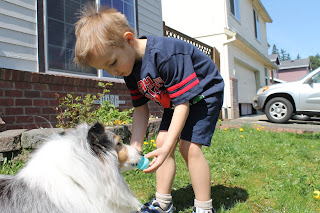
The Easter bunny was good to us this year. And, after all the fun inside, we took the dogs out to the front yard to find what the Easter bunny had left for them. All across the lawn were brightly colored plastic eggs filled with dog treats. Ethan couldn't resist the fun and helped the dogs find and open the eggs. Happy Easter!




 H
H


Wednesday, April 4, 2012
How Much is That Doggy in the Window: What to Know When Getting a Dog
Honestly, the biggest problem I see when training dogs (and their owners!) isn't jumping up, running away or housetraining. By far, the biggest issue is people getting a dog that wasn't a good match for their family. The article Getting a Dog addresses the important qualities to consider before selecting your next dog.
 Learn when the perfect time is to bring a new dog into your home, based on your living situation, the time of year and more. Look at the pros and cons of getting a puppy, young adult or senior dog, as well as which is a better match for you - purebred or mixed breed.
Once you've determined that the time is right and you've closely considered what type of dog fits your life, it's time to examine your options of where to get your new dog. Learn more about well-run animal shelters and rescue groups and how to identify and avoid rescue groups that don't act with the dog's best interest at heart. If you decide to purchase a dog from a breeder you'll have lots of research to do, but our Selecting a Good Breeder article will help you ask all the right questions.
Lastly, learn why it is so important NEVER to buy a puppy (or anything else) from a pet store or a backyard breeder.
Once you've read about how to select a dog that's a good match for you and your family, you might find you still need some help. If that's the case, please don't hesitate to ask! Email me or call me at 503.686.5890. The most important decision you make about your new dog happens before you even bring him/her home!

Once you've determined that the time is right and you've closely considered what type of dog fits your life, it's time to examine your options of where to get your new dog. Learn more about well-run animal shelters and rescue groups and how to identify and avoid rescue groups that don't act with the dog's best interest at heart. If you decide to purchase a dog from a breeder you'll have lots of research to do, but our Selecting a Good Breeder article will help you ask all the right questions.
Lastly, learn why it is so important NEVER to buy a puppy (or anything else) from a pet store or a backyard breeder.
Once you've read about how to select a dog that's a good match for you and your family, you might find you still need some help. If that's the case, please don't hesitate to ask! Email me or call me at 503.686.5890. The most important decision you make about your new dog happens before you even bring him/her home!
Subscribe to:
Posts (Atom)