Showing posts with label Dog Training Beaverton OR. Show all posts

Tuesday, May 1, 2012

Why Won't My Dog Listen to Me?

One of a dog owner’s greatest frustrations can be a dog that doesn’t listen to what they are told to do.  You may feel that you spend an endless amount of time calling your dog into the house, trying to keep them from jumping, or attempting to get their attention when you are out for a walk.  Or maybe there are simply times you feel your dog has very selective hearing.

All dogs can be good listeners, but they need the proper guidance and relationship with their owners to achieve this.  If your dog doesn’t listen to you, one of the following is probably the reason.

You aren’t as much fun as whatever your dog is doing.  Many of the occasions when our dogs tune us out are simply because there is something more interesting to do.  If you are trying to call your dog in from the backyard and aren’t getting any response, your dog has probably learned that there is a greater reward in ignoring you – more squirrels to chase, more time to smell the grass, etc.  Plenty of dogs listen well at home, but when they are taken out, to the park or into town, they quickly stop listening to even the simplest commands.  In any of these situations, getting upset or frustrated won’t make your dog any more likely to pay attention.  The only way to get your dog’s attention is to become more interesting than whatever they are currently doing.  Make yourself fun, make yourself interesting, and make yourself exciting!

Fear of punishment.  If you correct your dog for something, you should be confident that you are addressing a behavior that you do not want repeated, and that your dog will associate the correction with that exact behavior, not something else.  For example, if your dog gets out the front door and leads you on an hour long chase through the neighborhood, chances are by the time you catch up to him you will be quite frustrated, if not outright angry.  However, if you punish your dog for finally returning home (or merely allowing themselves to be caught), your dog will associate that correction with the last action they took – coming back.  Because dogs have relatively short attention spans, they cannot make the connection between what you are frustrated with (the bolt out the door that happened an hour ago) and the punishment they are receiving now.  That means that if you correct him when he comes back, next time he won’t want to come when you call him.  Using positive methods instead of punishment based training will ensure you never make a mistake like this.

Your dog hasn’t been formally trained.  Many owners expect their dogs to respond to commands that haven’t ever been officially trained.  You may think your dog knows how to do something, but they may in fact have only gotten lucky in responding properly.  Or maybe they do have a little understanding of what you are asking, but don’t know well enough to be able to perform around distractions, when they are tired or bored or in a different situation.  Our dogs genuinely want to do the right thing, but we need to give them the tools.  If you feel your dog isn’t listening because she’s just being difficult or stubborn, consider that maybe she just doesn’t get it.  The easiest way to fix this problem is to do some formal training: go to a class, get a private lesson from a professional trainer or find a good book.  Educate yourself so you know the right way to teach your dog.

You’re speaking the wrong language – English!  Let’s face it; we are a very ego-centric species.  Without even knowing it we often expect our dogs to act the way we would.  It’s the only way most of us know how to behave.  But when we expect our dogs to understand us or act like us, we are usually asking too much.  If you’ve ever thought of your dog as your child, talked in complete sentences and sort of expected an answer, or felt like your dog was holding a grudge against you, you’re guilty.  Don’t worry – it happens to the best of us.  However, if your dog seems to be ignoring you, maybe it’s just a “language barrier” of sorts.  You speak English and she speaks canine.  And it’s not just about interpreting a bark.  Dogs are very tuned into body language.  They communicate mostly through posture, movement, eye contact…all without a single spoken word.  The next time your dog doesn’t listen to you, consider if she really understands the question.

If your dog is not listening, regardless of why, the best solution may be found through a professional dog trainer.  Good dog trainers don’t just know how to get a dog to sit, they can interpret relationships between dogs and owners and help you learn how to improve them.  That leads to a happy ending for both you and your dog, and lots more listening!

Friday, April 20, 2012

Technical Difficulties and Brody the Havanese

The good news is that the dog training is going well.  The bad news is that the video I'm trying to take of said dog training is not cooperating.  You'd think with multiple digital cameras (all with video recording capability and one with HD video), a phone (also with HD video, of course) and an actual video camera, something in my house would be able to capture the wondrous moments of my little board & train, Brody, learning to target.  But the problem, I'm finding, is that these video-recording devices want to be smarter than me.  Maybe they are.  At any rate, I am now waiting for my son's camera battery to charge (no, I don't want to hear about how I am using my five-year-old's camera to make a professional training video for my company).  Once that has completed I should be good to go and can resume working on Brody's target training.

You haven't met Brody yet.  He is a very sweet 5 1/2 year old Havanese who has an unfortunate habit of reacting (boldly and loudly) to other dogs when he is on a leash.  He's a good example of how one or two incidents can dramatically impact a dog - Brody has been attacked by another dog and has now taken on the attitude of "I'm gonna get you before you can get me!" 

On leash reactivity is a frustrating problem for many owners.  Their dog, who might be fine when meeting other dogs in a different situation, will turn into a little furry lunatic when faced with the scary prospect of seeing something that might hurt them (strange dog) when they are trapped, unable to escape (leash). 

Scared is an important part of the equation to remember.  To some owners it can be very difficult to imagine that their dog is acting out of fear.  The other dog may be posing no real threat, but reality is in the eye of the beholder.  When your dog initiates the altercation, barking and carrying on in a "Come on, you want a piece of me?!!? Bark! Bark! Growl.  I'll kick your butt!!! Bark! Bark!" fashion, how could he be afraid?  The answer, we think, is that the dog is acting in a manner that he believes will scare off the other dog, thus avoiding an actual fight. 

In many cases, without realising it, we are allowing this flawed presumption to be reinforced.  Any time the other dog leaves when your dog is reacting (even if they were just heading in the other direction any way), your dog gets to think, "Hey, all that carrying on worked!  I didn't get attacked and the other dog is leaving.  I guess I'll try that next time too."

So what do you do to prevent this very embarrassing and highly stressful situation from reoccurring every time you cross paths with another dog?  I do suggest getting professional help, as this can be a potentially dangerous situation, and your dog is showing pretty clearly that all is not right with their world.  But here are a few things you can do to keep things under control until a trainer gets you working on a specific behavior modification plan.

  1. Don't add more negative to an already scary situation.  It's likely that your dog is truly afraid and isn't displaying this unruly behavior just to irk you (dogs may poop on your rug or chew up your new shoes, but they are not capable of being vindictive - that charming trait is reserved for homo sapiens).  Correcting or punishing your dog only makes things worse, even if it appears to have a positive effect in the beginning.  Leash popping, poking, "psst'ing" or "alpha rolling" are unacceptable responses and are more likely to get you bit than they are to solve the problem.  Just because it's on TV doesn't make it true.
  2. Don't reinforce the behavior either.  Rewarding your dog, either intentionally or unintentionally gives your dog positive feedback for a reaction we don't want to continue.  Stroking him and "reassuring" him with "it's okay puppy, you're alright, you're my good boy" acts as reinforcement.  In addition, the more you fuss over the situation the more likely you are to send the message to your dog that something really is wrong - look how worked up Mom is getting!
  3. Stay below your dog's threshold whenever possible.  Threshold is a complex thing, but it's more or less the point at which your dog feels the need to react.  Going above your dog's threshold means he'll probably start barking, growling, lunging or exhibiting other "bad" behavior.  Threshold is not a static thing - it can be influenced by distance, intensity, size, gender, direction and many other factors.  Keeping your dog below threshold may simply be a matter of crossing the street when you see another dog approaching or walking your dog at a time of day that isn't as busy.
  4. Turn and walk the other way.  Remember the part about your dog thinking that his behavior chased the other dog away?  While it probably won't solve your dog's issues alone, it doesn't hurt to try to have your dog "leave" rather than letting him feel that all the barking and ugly behavior caused the other dog to go away.  If your dog does go over threshold and reacts to a dog he sees, do your best to get him turned around so you are the one that walks away.
Addressing a behavior problem like on-leash reactivity is usually a matter of combining management and behavior modification.  The right mixture will keep your dog (and those he encounters) safe during the training process, and allows the behavior modification to be as effective as possible.  There are good techniques available to counter reactivity, and Brody is getting the full experience.  Hopefully he'll continue to learn quickly, soaking up everything he needs to have him feel more comfortable around other dogs when he goes out for a walk.  His owners enjoy traveling in their RV with him, so it's important for everyone.

Are there things that your dog reacts to, either on leash or off?  Other dogs, new people or children?  The evil dog-hunting vacuum cleaner?


Ethan and Brody

Tuesday, April 17, 2012

Clicker 101 - Part One

Have you heard about clicker training, but don't know what it is?  How it got started?  Why they are used?  What all the fuss is about?  And, hey, are they worth it, or is the clicker just another gizmo you'd be forced to juggle, as if the dog, leash, treats and poop bags weren't enough?!

I'll start with some of the history of clicker training, and what it does, and then (in the interest of brevity, so this post stays short enough for you to read and me to write) I'll go into more detail in follow up posts.  Like how to use a clicker, and common concerns about clicker training.  I'll probably throw in a video at the end, so you can see clicker training in action and decide for yourself what you think of it (though I think trying it with your dog for a few weeks is the best way to give it a true trial).

So, where did clicker training begin? The concept originated around the time of WWII with Marian Kruse and Keller Breland, students of the famous B. F. Skinner.  They used clicker training to teach a wide animals including pigeons, cats and dolphins.  Its use in training marine mammals took off (instead of a click trainers use the high pitched whistle we now associate with Flipper and Shamu, but the concept is the same), but clicker training still hadn't really made it to dogs.

One behavior expert was using clicker training with dogs though, and in 1992 Karen Pryor put on a seminar in San Diego, California that would change the face of dog training forever.  Along with her book, Don't Shoot the Dog, Pryor began to spread awareness of clicker training and the fantastic results it could bring when teaching obedience commands or modifying behavior.

The basic principles of clicker training are quite simple.  The "click," that sound made by the clicker, becomes what is known as a conditioned reinforcer.  It is a sound that initially means nothing to a dog; it is quite literally just a click.  But, after repeated pairings with food rewards, the click begins to take on meaning.  It starts to mean "Yes! You got it right!"  It means food is coming, even if you can't see it yet.  And it means "All done!" that whatever behavior they have been working on is complete.

How does one sound come to mean so much to a dog?  That's where the "conditioned" part of conditioned reinforcer comes in.  Let's use dolphins as an example.  It's one of my favorites, as you know if you've learned clicker training with me.  Training a dolphin offers some unique challenges.  You can't put a choke collar on a dolphin and make it mind.  You can't flip it over and pin it to the ground, exerting your "dominance" over him, the way some famous "trainers" would. (Since we can't express sarcasms well in the written word, let me just insert that here. I do not advocate choke collars or dominating your dog, or any creature for that matter.  Sarcastic sneer noted.)

Dolphins also swim much better than we do, which makes it hard for us to be near them when they are performing tricks.  Training dogs is starting to sound pretty easy, right? Clicker training (or "marker training" - a more general term that can include other types of sounds like the whistle that marine mammal trainers are likely to use) helps with dolphin training in many ways.  First, by giving the dolphins a consistent, easy to recognize cue that means the dolphin has done something right, we improve communication and thus speed up training.  Marking the exact moment a dolphin performs also allows the trainer to reward for increments of behavior, not just the final product. 

Finally, the whistle acts as a bridge (lots of fancy terms this time!).  A bridge (in normal-person language) is a way to increase the amount of time between when the behavior is performed and when the reward is received, without ruining the animal's understanding of why they are being rewarded.  Think of a dolphin learning to jump up and touch a ball suspended 20 feet above the pool. (I have no idea about dolphin training, and it's been a while since I've seen a show, so forgive me if my example is totally inaccurate.)  It would be nearly impossible to get a fish to the dolphin at the exact moment that he touches the ball, since the dolphin is way out in the middle of the pool (and 20 feet in the air!) and the trainer is stuck on their little platform.  If the dolphin doesn't get his fish within a few seconds of performing the behavior, he won't connect the two.  Enter marker training (clicker training if you missed all the bouncing around with terminology)!  Because the dolphin has been conditioned to know that the whistle means a fish is coming, the trainer blows the whistle at the exact moment the dolphin touches the ball and, bingo!  Dolphin makes the connection and learns the new behavior.  And you and your friends pay an arm and a leg to see his show.

What does all this mean for you and your dog?  Clicker training isn't just a gimmick, but an effective method based on scientific learning principles.  Using a clicker allows you to be clear and consistent in your communication about when your dog has done something right, and also allows you to break a behavior into smaller parts as they are learning.  And once your dog is conditioned to the clicker, you can afford more time between the time the dog does a behavior and the time your get the reward to him.

Saturday, April 14, 2012

And the Winner Is...

My husband and I had a wonderful time tonight at the Pilgrim Lutheran School fundraising auction and dinner.  Bravo Dog Training raised some money for the school with a dog training basket - full of great toys, treats and more, plus a certificate for either a board and train program or private lessons.  I didn't see the final bid, but I know we raised about $400 for Ethan's school.  Thanks to everyone who bid!

Here's Ethan with me, ready to head out to the auction.  It was a country-western theme, hence the blue jeans.  Yes, I do wear pants other than blue jeans; it has been known to happen.  Once or twice.  Ethan played with the other kids in a babysitting room, so Mom and Dad got to enjoy the night like proper grown ups.  It was a fun event.


Earlier today I had an initial session with a wonderful couple from our church, Cedar Hills United Church of Christ.  They have a very enthusiastic 2-year-old Lab who will be a ton of fun to train.  The family has been through a couple other trainers that they weren't happy with, but after our session today they asked to schedule 6 additional sessions!  I think it will be a good match, and I'm happy that they have found a trainer that can work with them to mold their zealous (okay, cover your ears puppy, obnoxious) Labrador into a model citizen.  Oh, and I'm happy that trainer is me!  I do love the wild and crazy dogs.  It is so much fun to take all that energy and redirect it to positive, useful behaviors.

One problem that we got to work on right away was the dog's habit of darting out the front door and playing a joyous (for the dog, let me be clear. Owners, not-so-joyous) game of catch-me-if-you-can.  Let's be honest, even for an Olympic level sprinter (which no one in this family is, to my knowledge), catching a long-legged 90 lb lean-mean-Labrador-running-machine is hopeless for us bumbling 2 legged humans.  I wrote a piece not long ago on "un-training" a dog to come when called.  Their dog was a good example of this.  The solution?  Going back to square one and training the dog to come using my "hidden food" recall method, teaching "wait" at the front door (and when coming out of the crate, just for extra training opportunities), and a strict ban on any chances to get out the front door until he is fully trained.

Do you know a dog that doesn't come when called?  Even a dog that comes 90% of the time isn't trained well enough - that 10% can be anything from frustrating to fatal.  But it is a fixable problem!

Wednesday, April 4, 2012

How Much is That Doggy in the Window: What to Know When Getting a Dog

Honestly, the biggest problem I see when training dogs (and their owners!) isn't jumping up, running away or housetraining.  By far, the biggest issue is people getting a dog that wasn't a good match for their family. The article Getting a Dog addresses the important qualities to consider before selecting your next dog.

Learn when the perfect time is to bring a new dog into your home, based on your living situation, the time of year and more. Look at the pros and cons of getting a puppy, young adult or senior dog, as well as which is a better match for you - purebred or mixed breed.

Once you've determined that the time is right and you've closely considered what type of dog fits your life, it's time to examine your options of where to get your new dog. Learn more about well-run animal shelters and rescue groups and how to identify and avoid rescue groups that don't act with the dog's best interest at heart. If you decide to purchase a dog from a breeder you'll have lots of research to do, but our Selecting a Good Breeder article will help you ask all the right questions.

Lastly, learn why it is so important NEVER to buy a puppy (or anything else) from a pet store or a backyard breeder.

Once you've read about how to select a dog that's a good match for you and your family, you might find you still need some help. If that's the case, please don't hesitate to ask!  Email me or call me at 503.686.5890. The most important decision you make about your new dog happens before you even bring him/her home!

Thursday, March 22, 2012

Double Trouble: Dori and Apple

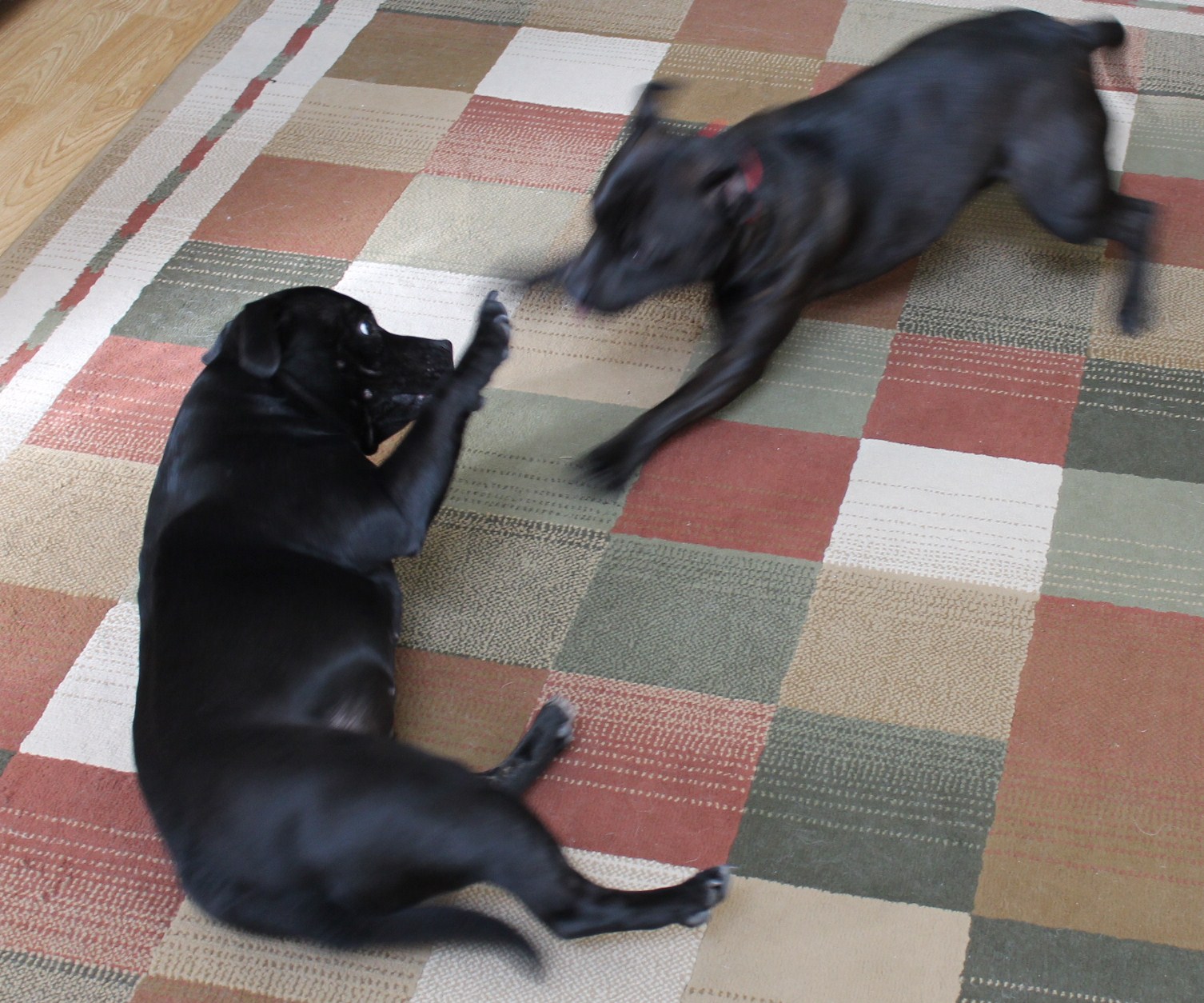
We have a visitor, Dori, a one-year-old Staffordshire Bull Terrier (she's the one in the red collar).  In between training and sleeping has been playing - lots and lots of playing!  Dori gets along well with all our dogs (and Ethan), but it is especially cute to see her playing with Apple.  They are quite a sight together!  Here are some of the moments I've captured. (For larger, higher quality images click on a photo.)


Wednesday, March 7, 2012

New Age Pet Tags

It seems like everything these days revolves around our smart phones.  Don't expect our pets to be left behind.  Some things are very high tech (and expensive!), like GPS tracking that can give you the exact location of your dog - or at least his collar - if he gets lost.  But there's a new one that's a little more realistic for the average pet owner.

Pet Hub, a Washington based company, offers dog and cat ID tags with a QR code - that funky square barcode that can be read by your smart phone.  When someone scans the code they are taken to your dog's very own web page.  You keep this page updated with their current information.

The individual web page gives you room for a lot more information than would fit on a tag.  You can list the typical name, address and phone number, and also your veterinarian, any medications, allergies, important behavior issues (like "can climb fences!" or "doesn't like cats"), reward info and even photographs.  Update the information anytime you want - if you move, if their medications change or anything else - you are in charge.  The Pet Hub tag also features a unique web address that can be manually entered, in case your pet is found by someone less technically inclined. 


Saturday, March 3, 2012

Why I Have The Best Job In The World

10. My work is flexible.  I can be returning phone calls at 9 AM in my PJs, then off to the grocery store, then home again before a private lesson.  It allows me to work in doctor's appointments, time with friends and preschool events.

9. I make a comfortable income.  Not long ago I applied to Petsmart for an open dog trainer position.  I thought it would be easier than starting my business over again in a whole new community.  They offered me the job, but for what they would have paid me I'd need to work an entire day to make what I currently bring in for one hour-long private lesson.  I won't buy a luxury vacation home on my income, but it works for us.

8. I get to work with an endless variety of different dogs.  All different breeds, ages, personalities and problems and successes.

7. My dogs get to be part of my day, all the time.  Even better than "take your dog to work day," I get to involve my dogs in my work.

6. My work is varied.  I do marketing, customer service, accounting, continuing education, networking... there's always something different to do.

5. Puppy breath.  Need I say more?

4. I meet wonderful people.  I am welcomed into my client's homes and their lives.  Many of my clients have become close friends and have provided support for me when I've needed it.  It wouldn't be the same without all the amazing clients.

3. I am my own boss.  It's just so cool to be in charge of yourself.

2. My job allows me to be, in some ways, both a stay-at-home mom and a working mom at the same time.  It's always a precarious balance, but I love the way my job lets me be close to my son and to be far more involved in his life than I would be if I spent 8 hours a day in a cubicle somewhere.

1. Dog training is my passion.  I'd do it for free (but sorry guys, the utility companies, the grocery store and the landlord don't feel the same way!).  What more could you ask for in life?
Mary Majchrowski and her son, Ethan at Mount Hood, OR
February, 2012

Friday, February 24, 2012

How Comfy is Your Best Chair?

Photo (c) 2012 Faith Hague

Leo, a Spinone Italiano mix, has learned to behave well when he's in a comfy spot, thanks to resource guarding behavior modification training through Bravo Dog Training (boy, that's a mouthful!).  Resource guarding is a natural behavior that occurs when a dog wants to protect something he finds valuable - like a great sleeping spot or a rawhide bone.  Dogs can resource guard any number of objects, including food, toys, beds, bones and even people.

Changing the behavior is about changing the dog's perception of our approach and interaction when the dog has something he feels is worth guarding.  Contrary to long held beliefs, the best way to stop resouce guarding behavior in dogs is not to challenge the dog and "put him in his place," but to make him see our presence as a good, safe thing.  Does Leo look like he feels safe?

For additional information on resource guarding, check out the January 2011 issue of The Bravo Bark: http://www.mybravodog.com/January_2011.html Thanks to Faith Hague of Camden, Maine for the great photo!