Friday, May 18, 2012

Rest In Peace Snowborn's Cedar Mesa Timber

Today we said goodbye to one of our own - our Siberian husky, Timber.  Words fail me, so pictures will have to do.  We'll miss you big guy.


Saturday, May 12, 2012

Children and Puppies: Handling Chasing and Biting

I have several clients right now with young puppies and young children.  It can be a precious mix, especially when the kids are just old enough to be helping feed, walk and train their new family member.  It can be an adorable, fun interaction. That is, until those kids are ready to burn off some energy and start racing around the house or yard with the puppy snapping after them like a furry little alligator. 

"How do we handle this?" the parents want to know.  It partly depends on the age and training level of the puppy, but in general, you begin with management and progress to training.  That's to say, when the puppy is very young your best bet is to manage the situation.  As puppy grows training will play more and more of a role until management is no longer an important part of the picture.

So what is management versus training?  In the case of a puppy chasing, jumping on and biting at children who are playing wildly, management will start with the use of a crate.  When the children are playing quietly they should be taught how to interact properly around the puppy, but all kids have those times where they are over-the-top with energy - this is a time to put the puppy in its crate, along with a stuffed Kong or a safe chew toy.  It's just not fair to expect your children to change their behavior (they are truly being children after all), and it's not fair to ask your puppy to ignore everything instinctual (running, chasing, tackling and biting that squealing human puppy).

As the puppy matures a little and gets some training, it's time to move onto a new phase of management.  Instead of crating your puppy when the kids are being wild, try putting the puppy on a leash and allowing them to watch, but not join in, the craziness.  Try to keep your puppy busy with some easy obedience training (don't forget your treats and clicker), games or toys.  If puppy finds it too frustrating then he or she may not be quite ready to move beyond quiet time in the crate.

Once your puppy can handle things on leash, the next step is allowing the puppy to remain loose while the children play, closely supervised by you.  Use the time to practice some recalls (coming when called).  Give lots of praise for every successful recall - that's a tough exercise!  This is also a great opportunity to work on down-stay or "settle."

Keep things fun and positive, and remember, be sure to set your puppy up for success.  These first few months are setting the stage for the behavior and relationship you get with your puppy over the next 12 or more years.  Take the time to do it right and you will be rewarded many times over!

Tuesday, May 8, 2012

Dog Food Recalls

Please be aware that there are several active dog food recalls at the moment.  We want to keep our pets healthy, so take a moment to review the lists.  The primary culprits are Diamond Pet Foods - involving a number of brands, including (but NOT limited to), Call of the Wild, Chicken Soup for The Pet Lover's Soul, and Diamond varieties, and other brands that have some of their food manufactured at Diamond plants:  Wellness Dry Dog Food, Canidae Dog Food, Natural Balance Dog Food, and Solid Gold.  Again, this is not a comprehensive list.  For a complete list, as well as up-to-date details, visit Dog Food Advisor or the Food and Drug Administration (FDA) which oversees the pet food industry. 

Tuesday, May 1, 2012

Why Won't My Dog Listen to Me?

One of a dog owner’s greatest frustrations can be a dog that doesn’t listen to what they are told to do.  You may feel that you spend an endless amount of time calling your dog into the house, trying to keep them from jumping, or attempting to get their attention when you are out for a walk.  Or maybe there are simply times you feel your dog has very selective hearing.

All dogs can be good listeners, but they need the proper guidance and relationship with their owners to achieve this.  If your dog doesn’t listen to you, one of the following is probably the reason.

You aren’t as much fun as whatever your dog is doing.  Many of the occasions when our dogs tune us out are simply because there is something more interesting to do.  If you are trying to call your dog in from the backyard and aren’t getting any response, your dog has probably learned that there is a greater reward in ignoring you – more squirrels to chase, more time to smell the grass, etc.  Plenty of dogs listen well at home, but when they are taken out, to the park or into town, they quickly stop listening to even the simplest commands.  In any of these situations, getting upset or frustrated won’t make your dog any more likely to pay attention.  The only way to get your dog’s attention is to become more interesting than whatever they are currently doing.  Make yourself fun, make yourself interesting, and make yourself exciting!

Fear of punishment.  If you correct your dog for something, you should be confident that you are addressing a behavior that you do not want repeated, and that your dog will associate the correction with that exact behavior, not something else.  For example, if your dog gets out the front door and leads you on an hour long chase through the neighborhood, chances are by the time you catch up to him you will be quite frustrated, if not outright angry.  However, if you punish your dog for finally returning home (or merely allowing themselves to be caught), your dog will associate that correction with the last action they took – coming back.  Because dogs have relatively short attention spans, they cannot make the connection between what you are frustrated with (the bolt out the door that happened an hour ago) and the punishment they are receiving now.  That means that if you correct him when he comes back, next time he won’t want to come when you call him.  Using positive methods instead of punishment based training will ensure you never make a mistake like this.

Your dog hasn’t been formally trained.  Many owners expect their dogs to respond to commands that haven’t ever been officially trained.  You may think your dog knows how to do something, but they may in fact have only gotten lucky in responding properly.  Or maybe they do have a little understanding of what you are asking, but don’t know well enough to be able to perform around distractions, when they are tired or bored or in a different situation.  Our dogs genuinely want to do the right thing, but we need to give them the tools.  If you feel your dog isn’t listening because she’s just being difficult or stubborn, consider that maybe she just doesn’t get it.  The easiest way to fix this problem is to do some formal training: go to a class, get a private lesson from a professional trainer or find a good book.  Educate yourself so you know the right way to teach your dog.

You’re speaking the wrong language – English!  Let’s face it; we are a very ego-centric species.  Without even knowing it we often expect our dogs to act the way we would.  It’s the only way most of us know how to behave.  But when we expect our dogs to understand us or act like us, we are usually asking too much.  If you’ve ever thought of your dog as your child, talked in complete sentences and sort of expected an answer, or felt like your dog was holding a grudge against you, you’re guilty.  Don’t worry – it happens to the best of us.  However, if your dog seems to be ignoring you, maybe it’s just a “language barrier” of sorts.  You speak English and she speaks canine.  And it’s not just about interpreting a bark.  Dogs are very tuned into body language.  They communicate mostly through posture, movement, eye contact…all without a single spoken word.  The next time your dog doesn’t listen to you, consider if she really understands the question.

If your dog is not listening, regardless of why, the best solution may be found through a professional dog trainer.  Good dog trainers don’t just know how to get a dog to sit, they can interpret relationships between dogs and owners and help you learn how to improve them.  That leads to a happy ending for both you and your dog, and lots more listening!

Thursday, April 26, 2012

Springtime Fun

This past weekend was beautiful - sunny and warm and ideal for being outside.  We had lots of fun being in the backyard, and the dogs enjoyed it too.  Ethan had been pestering me to use his new water balloons, so I finally relented.  I sat at the hose and filled and tied, filled and tied.  It was hard to stay ahead of Ethan as he would throw the balloons just about as fast as I could fill them, but we both had a good time.

Pistol is always excited for anything involving water, especially if the hose is out.  He's also an avid ball chaser, so Ethan had some fun throwing the balloons for Pistol.  Poor Pistol would excitedly chase after the balloon, then spin in confused circles where it had landed, looking for what he had been chasing.  It felt a little cruel, but the tail kept wagging and he kept asking for more.  I think Pistol is happy to chase regardless of the outcome.  A couple times he got ahead of Ethan and actually managed to "catch" the balloon.  Not better results than chasing it - there's still nothing to bring back, except a mouthful of water!

Monday, April 23, 2012

A Successful Day

Saturday was a great day of progress for Brody. We've been working up to it the whole time he has been training, building foundation, building trust and creating meaning for the clicker.  Saturday was the culmination of everything we had worked on, and the true beginning of his counter-conditioning training.  I was worried about how Brody would react - while he's done very well so far, there are lots of things that can go wrong once all the cards are on the table and he comes face to face with his nemesis. 

I was worried that he would get stressed out and refuse to take treats, that he would start to ignore the sound of the click, or that I wouldn't be able to keep him under threshold.  Those are all common road blocks when working with a leash-reactive dog, so I had reason to be concerned.  But all our prep work (and my thoughtful planning of bringing several different kinds of treats) paid off.

The park we picked to work in on Saturday was perfect for what Brody needed.  It was busy - with a sunny, mid-70's spring day that wasn't a surprise.  Lots of kids and parents, noise and activity, but that wasn't what we were there for.  I got Brody all set up, leash clipped to his harness, my treat bag and clicker ready, and we headed to the edge of the park, by the sidewalk that ran around the perimeter.  That's where we found what we were looking for - a woman walking her dog.  The first dog we spotted was small, which was fine for a starting point. 

I got Brody to a distance that I thought was just close enough (or just far enough, depending on how you want to look at things!), then proceeded to click and treat at all the right times.  It was a fantastic exercise - textbook.  My timing was good, and I managed to keep Brody just under threshold all but one time (which I caught so quickly it didn't become an issue).  We made it by that dog without a single bark, so I gave him a little break and grabbed a few pictures.  Once I'd spotted the next dog I again set Brody up at a distance that felt right, and we again had a very successful session.

Throughout the couple hours we stayed at the park Brody got to encounter many dogs, and he continued to do very well.  If you think two hours sounds like a long time to train a dog, you're right.  It's too long.  But sometimes you have to take advantage of situations that are ripe for training, so I kept Brody from getting frazzled by mixing things up and taking lots of breaks.  A little work passing another dog, then some time to sit in the shade and relax.  A walk around the grass for sniffing and exploring, a trip over to the car to get a drink of cold water and some fresh treats, then scoping out another dog and taking up our position.

It's wonderful as a dog trainer to have things go well, especially when you have eager parents putting their trust in you, hoping that you will make great progress with their dog.  We still have a long way to go, but right now I'm very happy with how Brody is doing.

Have you ever had a dog that was reactive (towards dogs, people, cars or anything) when on leash?  What did you do to change their behavior, or what did you do to deal with it?

Friday, April 20, 2012

Technical Difficulties and Brody the Havanese

The good news is that the dog training is going well.  The bad news is that the video I'm trying to take of said dog training is not cooperating.  You'd think with multiple digital cameras (all with video recording capability and one with HD video), a phone (also with HD video, of course) and an actual video camera, something in my house would be able to capture the wondrous moments of my little board & train, Brody, learning to target.  But the problem, I'm finding, is that these video-recording devices want to be smarter than me.  Maybe they are.  At any rate, I am now waiting for my son's camera battery to charge (no, I don't want to hear about how I am using my five-year-old's camera to make a professional training video for my company).  Once that has completed I should be good to go and can resume working on Brody's target training.

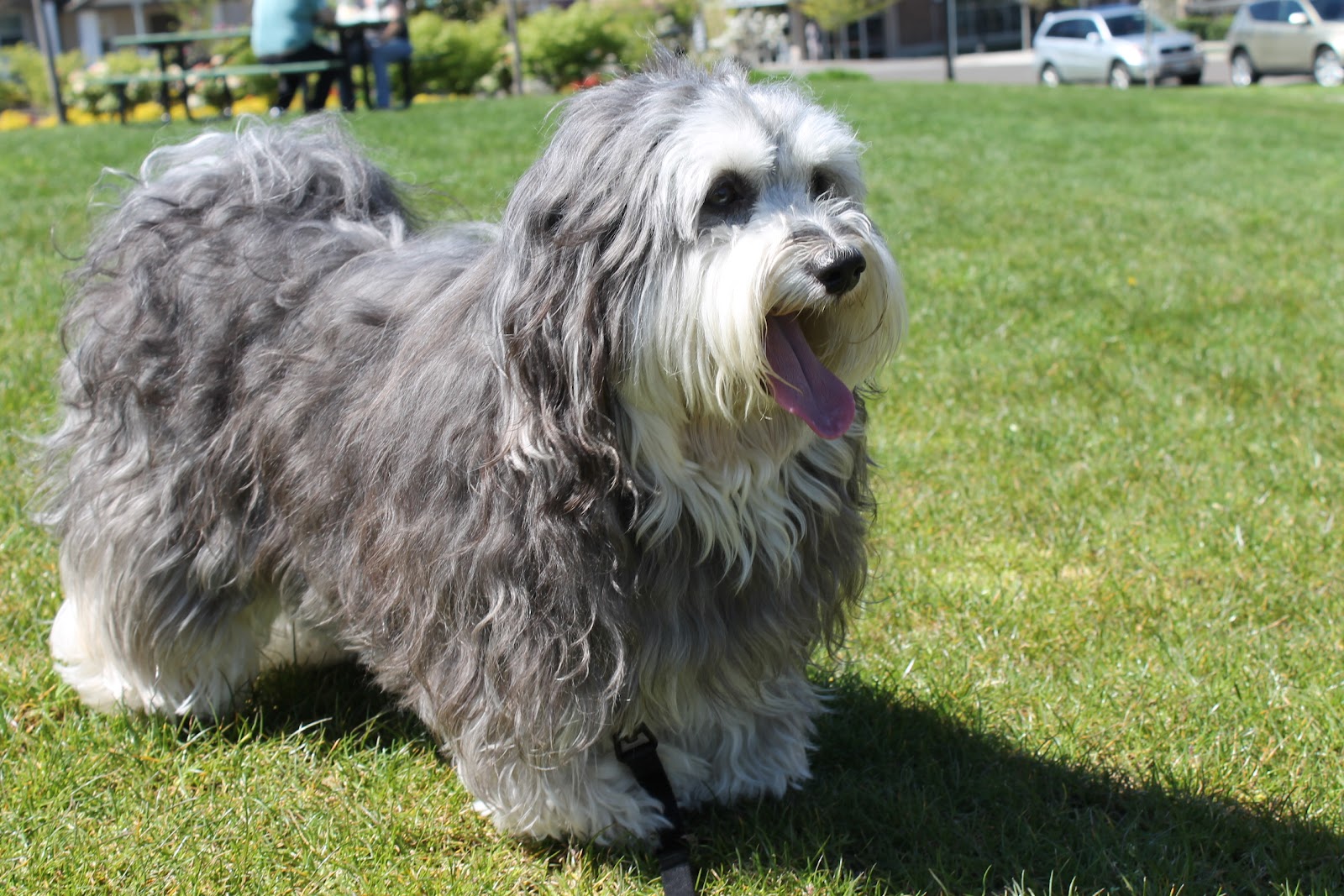
You haven't met Brody yet.  He is a very sweet 5 1/2 year old Havanese who has an unfortunate habit of reacting (boldly and loudly) to other dogs when he is on a leash.  He's a good example of how one or two incidents can dramatically impact a dog - Brody has been attacked by another dog and has now taken on the attitude of "I'm gonna get you before you can get me!" 

On leash reactivity is a frustrating problem for many owners.  Their dog, who might be fine when meeting other dogs in a different situation, will turn into a little furry lunatic when faced with the scary prospect of seeing something that might hurt them (strange dog) when they are trapped, unable to escape (leash). 

Scared is an important part of the equation to remember.  To some owners it can be very difficult to imagine that their dog is acting out of fear.  The other dog may be posing no real threat, but reality is in the eye of the beholder.  When your dog initiates the altercation, barking and carrying on in a "Come on, you want a piece of me?!!? Bark! Bark! Growl.  I'll kick your butt!!! Bark! Bark!" fashion, how could he be afraid?  The answer, we think, is that the dog is acting in a manner that he believes will scare off the other dog, thus avoiding an actual fight. 

In many cases, without realising it, we are allowing this flawed presumption to be reinforced.  Any time the other dog leaves when your dog is reacting (even if they were just heading in the other direction any way), your dog gets to think, "Hey, all that carrying on worked!  I didn't get attacked and the other dog is leaving.  I guess I'll try that next time too."

So what do you do to prevent this very embarrassing and highly stressful situation from reoccurring every time you cross paths with another dog?  I do suggest getting professional help, as this can be a potentially dangerous situation, and your dog is showing pretty clearly that all is not right with their world.  But here are a few things you can do to keep things under control until a trainer gets you working on a specific behavior modification plan.

  1. Don't add more negative to an already scary situation.  It's likely that your dog is truly afraid and isn't displaying this unruly behavior just to irk you (dogs may poop on your rug or chew up your new shoes, but they are not capable of being vindictive - that charming trait is reserved for homo sapiens).  Correcting or punishing your dog only makes things worse, even if it appears to have a positive effect in the beginning.  Leash popping, poking, "psst'ing" or "alpha rolling" are unacceptable responses and are more likely to get you bit than they are to solve the problem.  Just because it's on TV doesn't make it true.
  2. Don't reinforce the behavior either.  Rewarding your dog, either intentionally or unintentionally gives your dog positive feedback for a reaction we don't want to continue.  Stroking him and "reassuring" him with "it's okay puppy, you're alright, you're my good boy" acts as reinforcement.  In addition, the more you fuss over the situation the more likely you are to send the message to your dog that something really is wrong - look how worked up Mom is getting!
  3. Stay below your dog's threshold whenever possible.  Threshold is a complex thing, but it's more or less the point at which your dog feels the need to react.  Going above your dog's threshold means he'll probably start barking, growling, lunging or exhibiting other "bad" behavior.  Threshold is not a static thing - it can be influenced by distance, intensity, size, gender, direction and many other factors.  Keeping your dog below threshold may simply be a matter of crossing the street when you see another dog approaching or walking your dog at a time of day that isn't as busy.
  4. Turn and walk the other way.  Remember the part about your dog thinking that his behavior chased the other dog away?  While it probably won't solve your dog's issues alone, it doesn't hurt to try to have your dog "leave" rather than letting him feel that all the barking and ugly behavior caused the other dog to go away.  If your dog does go over threshold and reacts to a dog he sees, do your best to get him turned around so you are the one that walks away.
Addressing a behavior problem like on-leash reactivity is usually a matter of combining management and behavior modification.  The right mixture will keep your dog (and those he encounters) safe during the training process, and allows the behavior modification to be as effective as possible.  There are good techniques available to counter reactivity, and Brody is getting the full experience.  Hopefully he'll continue to learn quickly, soaking up everything he needs to have him feel more comfortable around other dogs when he goes out for a walk.  His owners enjoy traveling in their RV with him, so it's important for everyone.

Are there things that your dog reacts to, either on leash or off?  Other dogs, new people or children?  The evil dog-hunting vacuum cleaner?


Ethan and Brody